


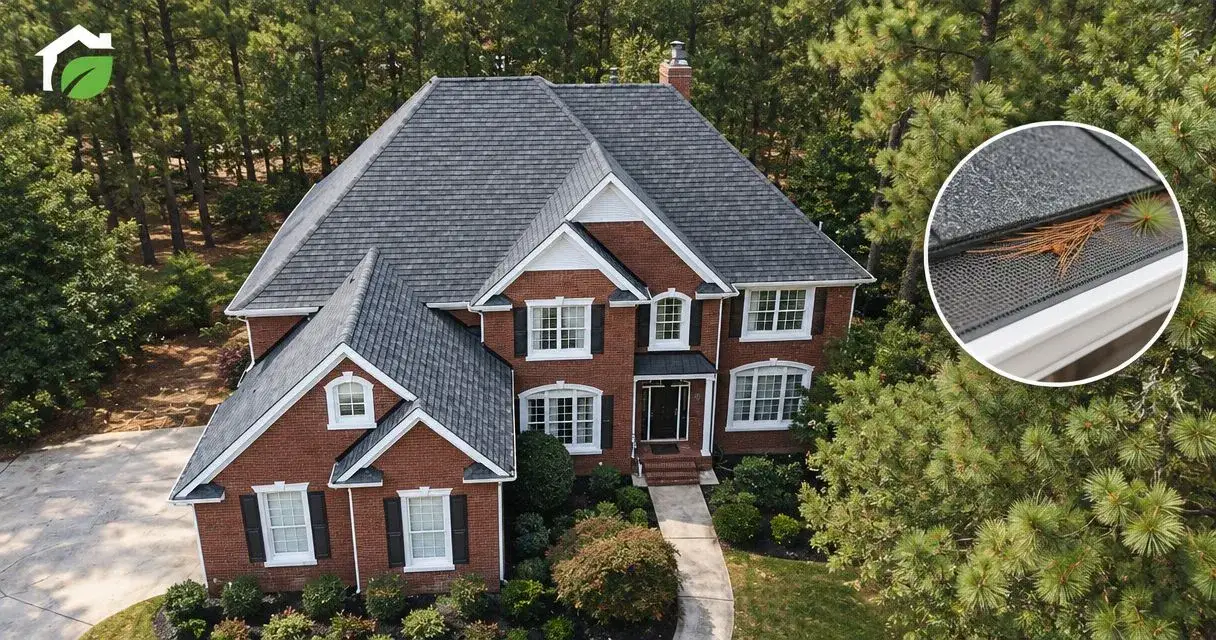
The best gutter guard for pine needles in Georgia is micro-mesh, because its fine openings stop needles, shingle grit, and pollen at the surface. Other guard types can work on lightly shaded homes, but under heavy pine cover most of them clog or let needles through.
TL;DR
- Micro-mesh is the best gutter guard for pine needles in Georgia: the openings are too fine for needles to pass.
- Surface-tension guards shed water well but let needles lodge at the nose of the guard.
- Perforated aluminum covers work for light pine cover; heavy cover needs regular brushing.
- Foam and brush inserts trap needles inside the gutter. Skip them under pines.
- Any guard fails on a sagging or poorly pitched gutter. Get the gutters inspected first.
Why pine needles are different from other debris
Oak leaves are big and sit on top of a guard. Pine needles are thin, stiff, and sticky with sap. They slip through standard screens, settle crosswise in the gutter, and knit together with pollen and roof grit into a dense mat.
Georgia makes it worse. Heavy spring pollen, summer storms that dump water fast, and humidity that keeps debris damp all stack on top of the needle problem. Wet needles rot into a sludge that holds water against the fascia.
That is why a guard that works fine for a maple-lined street can fail on a lot full of loblolly pines. If you are comparing options, start with how each design handles a needle, not a leaf. Our gutter guard installation page covers the basics of how guards fit onto a gutter system.
What makes the best gutter guard for pine needles
Judge every option against these criteria before you look at the comparison table:
- Opening size. Needles pass through anything with slots or holes wider than the needle itself. Fine mesh is the only design that blocks them outright.
- Surface behavior. Needles lie flat and can bridge openings. A guard needs a surface that sheds them in wind and rain instead of holding them.
- Water capture in heavy rain. Georgia thunderstorms overwhelm guards that shed water past the gutter. The guard has to keep water flowing into the trough.
- Cleaning effort. Every guard needs some maintenance under pines. The question is how often and how hard.
- Fit and roof compatibility. The guard must sit properly under the shingle edge without lifting shingles or leaving gaps pests can use.
- Gutter size. Standard 5-inch and 6-inch K-style gutters accept different guard sizes. A guard has to match the gutter you actually have.
Gutter guards for pine needles at a glance
| Guard type | Best for | Standout feature | Key limitation |
|---|---|---|---|
| Micro-mesh | Heavy pine cover | Blocks needles, grit, and pollen | Surface still needs occasional brushing |
| Surface-tension (reverse curve) | Mixed leaves with light pine | Smooth, solid hood | Needles catch at the nose and can overshoot in downpours |
| Perforated aluminum | Light to moderate pine | Rigid, simple, holds shape | Needles can lie flat and bridge or poke through holes |
| Foam insert | Nothing under pines | Easy to fit | Needles and pollen clog the foam |
| Brush insert | Nothing under pines | Cheap to try | Needles tangle in the bristles |
1. Micro-mesh: best gutter guard for heavy pine cover
Micro-mesh is a fine stainless or aluminum screen on a rigid frame. The openings are smaller than a pine needle, so debris rides on top and blows or washes off.
Micro-mesh pros:
- Blocks needles, shingle grit, and most pollen
- Handles Georgia’s heavy summer rain when installed at the right pitch
- Needs cleaning less often than any other guard type
- Works over seamless gutters without changing the gutter itself
Micro-mesh cons:
- Needles and pollen still film the surface and need brushing now and then
- Quality varies a lot between products; thin mesh can bend or sag
- Installation has to be precise or water can skip the gutter
Best for: homes directly under or beside mature pines.
Verdict: Buy.
2. Surface-tension guards: best for mixed trees
These are solid curved hoods. Water follows the curve and drops into a slot, while debris is meant to slide off the edge.
Surface-tension pros:
- Solid cover keeps most leaves and large debris out
- Strong, long-lasting body
- Good fit for yards with several tree types
Surface-tension cons:
- Pine needles catch at the slot and nose of the hood
- Heavy storm flow can overshoot the slot
- Cleaning means working around a fitted hood
Best for: yards with leaf trees and only a few pines.
Verdict: Hold. Fine for light pine exposure; not first choice for heavy cover.
3. Perforated aluminum covers: best for light pine cover
A flat or slightly curved aluminum panel with punched holes. It is rigid and simple.
Perforated aluminum pros:
- Sturdy panel that does not sag
- Stops larger leaves and sticks
- Straightforward to install and replace
Perforated aluminum cons:
- Holes are bigger than micro-mesh openings, so needles can poke through or bridge
- Sap and pollen clog the holes
- Needs more frequent brushing under pines
Best for: homes with a few pines and a homeowner willing to brush the covers.
Verdict: Hold.
4. Foam inserts: not for pine country
Foam wedges fill the gutter and let water soak through. Needles and pollen lodge in the foam, then moss and seedlings take root in it.
Foam pros:
- Easy to place without tools
- Blocks big debris from entering
Foam cons:
- Clogs from the top with needles and pollen
- Stays wet in Georgia humidity, which speeds decay
- Has to be pulled out and cleaned or replaced
Best for: nothing under heavy pines.
Verdict: Skip.
5. Brush inserts: not for pine country
A bottlebrush shape that sits inside the gutter. Needles tangle in the bristles and stay there.
Brush pros:
- Cheap and quick to try
- Works for large, loose leaves
Brush cons:
- Needles weave into the bristles and are hard to remove
- Debris sits inside the gutter, so water backs up
- Does not stop pollen or grit
Best for: nothing under heavy pines.
Verdict: Skip.
How we ranked
The ranking follows the criteria above: opening size first, then surface behavior, then how each design copes with Georgia storms and how often you will be cleaning. Pine needles punish any guard with large openings or interior fill, so those designs rank last.
What the guard cannot fix
A guard sits on top of a gutter. If the gutter has sagging runs, loose hangers, or the wrong pitch, water still pools and spills. Pine debris already packed in the gutter also has to come out before any guard goes on.
Sap and pollen build up on every surface, so plan on brushing or rinsing a guard even when it is the right type. Also confirm the guard sits properly under your shingle edge. A poor fit can lift shingles and invite water behind the fascia. If your roof is nearing the end of its life, replace the roof before adding guards so they are not pulled and reinstalled later. For a view of material options, see our guide to the best roofing materials for Georgia homes.
Cost depends on gutter length, gutter size, guard type, roof height, and how much repair the existing gutters need. Our gutter cost guide for Newnan explains those drivers.
Which gutter guard should you choose?
- Pines overhead or beside the house: micro-mesh.
- A few pines mixed with oaks or maples: micro-mesh, or a surface-tension hood if you accept more needle cleanup.
- One or two pines far from the roof: perforated aluminum can do the job.
- Anything involving foam or brush inserts: skip.
If your gutters are old or leaking at the seams, pairing new guards with seamless gutters removes the joints where needles collect.
FAQ
What is the best gutter guard for pine needles in Georgia?
Micro-mesh is the best choice because its openings are smaller than a pine needle. It also blocks pollen and shingle grit, which are heavy in Georgia.
Do gutter guards work with pine needles?
Fine micro-mesh guards do. Guards with larger holes or open slots let needles lodge or pass through, so they need more cleaning.
Do I still have to clean gutters with guards under pine trees?
Yes. Even micro-mesh collects a film of needles and pollen on top. Brushing or rinsing the surface a few times a year keeps water flowing.
Are foam or brush gutter guards good for pine needles?
No. Needles and pollen clog foam and tangle in brush bristles, and the debris stays inside the gutter.
Can gutter guards damage my roof?
A poorly fitted guard can lift shingle edges or leave gaps. A correct install sits under the shingle edge without pushing it up.
Should I replace my roof before installing gutter guards?
If the roof is near the end of its life, yes. Guards tuck under the shingle edge, so a later replacement means pulling and refitting them.
How much do gutter guards cost?
Cost depends on gutter length, gutter size, guard type, and roof height. A free inspection gives you a quote based on your actual house.
One last thing
Before you pick any guard, look at your gutters after a heavy rain with the pines in mind. If water spills over the front lip even when the gutters are clean, the problem is slope or hanger spacing, not debris. No guard fixes that, and an inspection catches it before you spend money.
Get your gutters checked
Hero Roofing offers free inspections for gutters and roofs across Newnan and the greater Atlanta area. Our team can tell you whether your gutters are ready for guards and which style suits your trees. Schedule your free inspection and we will look at the whole system.
Schedule a free inspection
Have our team check your gutters and roof before you choose guards.
